Delatr presents Lineage at the 17th Annual NMIOTC Conference
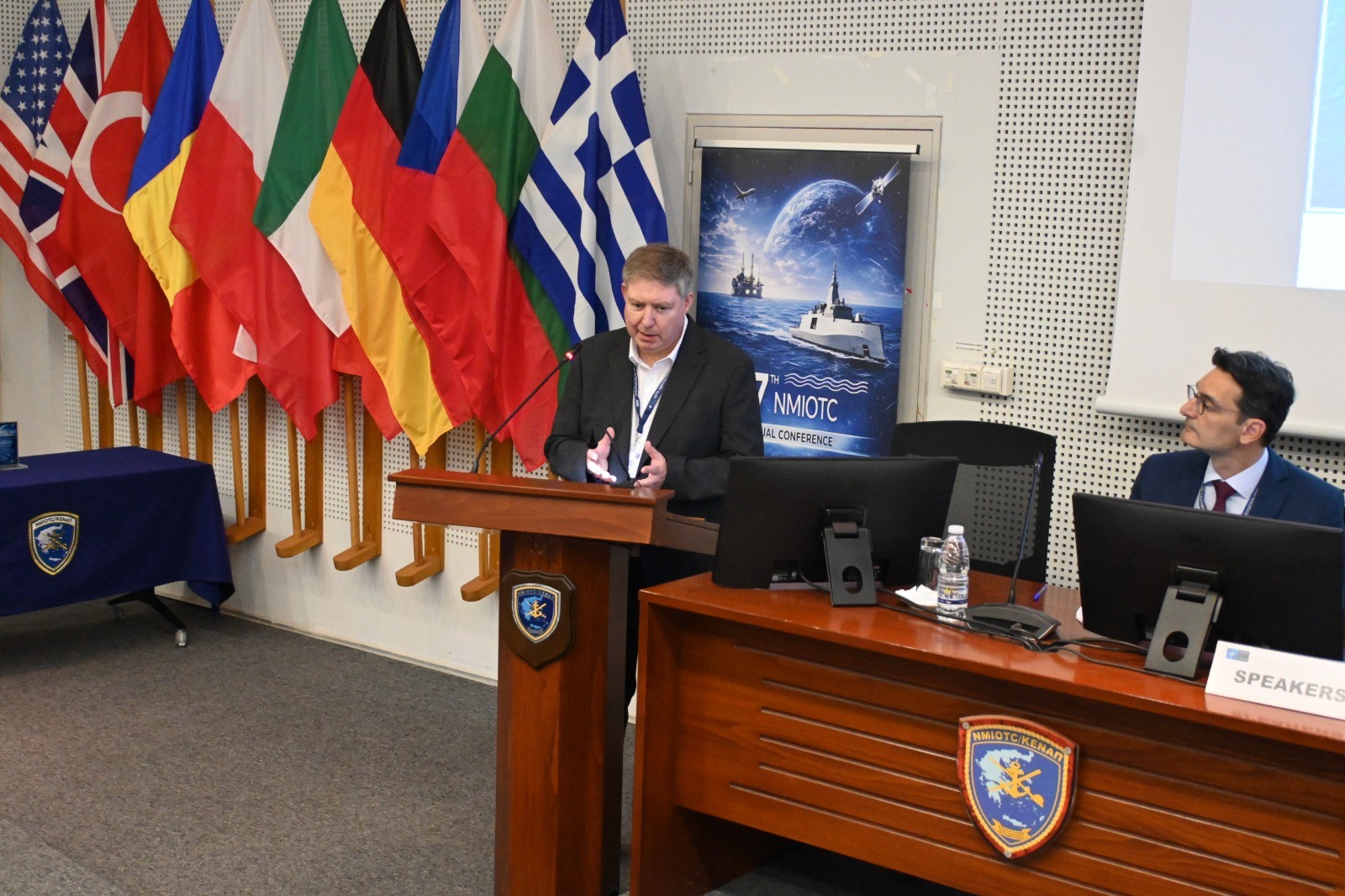
Last week, Delatr Technologies CTO and Co-Founder Adrian Neal took the podium at the 17th Annual NATO Maritime Interdiction Operational Training Centre (NMIOTC) Conference in Souda Bay, Crete.
Company
5 Min read
Our CTO and Co-Founder Adrian Neal presented at the 17th Annual NATO Maritime Interdiction Operational Training Centre (NMIOTC) Conference in Souda Bay, Crete, on 3-4 June 2026.
His presentation addressed the structural weaknesses in the encryption protocols currently protecting command and control links for unmanned and autonomous platforms, and outlined Delatr's approach to solving them with Lineage.
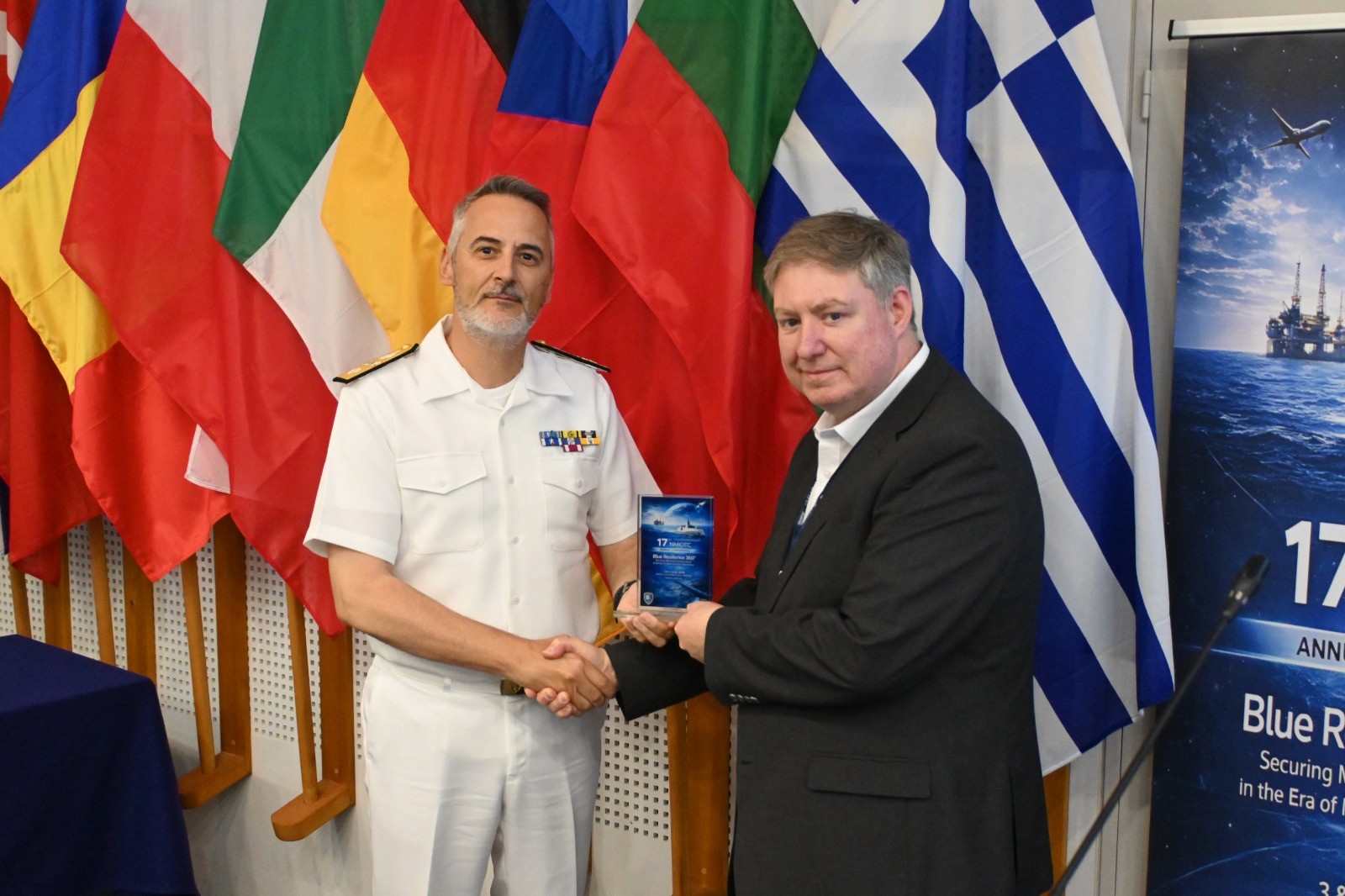
Adrian was recognised by the Commandant of NMIOTC for his contribution to the conference programme.
The conference
This year's NMIOTC conference was held under the theme "Blue Resilience 360°: Securing Maritime Infrastructure in the Era of Multi-Domain Operations." It brought together military, government, industry, and academic leaders from across the Alliance to address the evolving threats facing the maritime domain, with particular emphasis on the protection of critical maritime infrastructure.
Panel 6, "Innovation at Sea: Emerging Technologies for Maritime Protection and Deterrence," focused on unmanned systems, AI, and secure communication for maritime defence. Adrian's presentation sat within this panel.
NMIOTC is NATO's only fully accredited maritime education and training facility. The annual conference draws senior military officers, government officials, and defence industry leaders from across NATO member and partner nations.
The problem
NATO nations are accelerating unmanned system procurement at unprecedented rates. The UK alone has seen a 24,000% year-on-year increase in drone orders, with 200,000+ platforms targeted under Drone Dominance by 2027. Across the Alliance, autonomous platforms are being procured for aerial, maritime, ground, and subsurface operations.
Every one of these platforms depends on radio frequency links for mission commands, telemetry, sensor data, and coordination. Every one of those links is a target.
Electronic warfare capabilities deployed on today's battlefields are actively degrading and exploiting C2 links. Barrage jamming corrupts packets. Targeted interference breaks handshakes. Captured platforms yield encryption keys that compromise entire fleets. And behind all of it sits a longer-term strategic risk: harvest-now, decrypt-later. Adversaries recording encrypted transmissions today will be able to break them once cryptographically relevant quantum computers arrive.
The compliance timeline is already set. NIST depreciates RSA and ECC by 2030, with full prohibition by 2035. Australia mandates post-quantum compliance by 2028. The UK and Europe target 2030. Canada, 2031. Every platform procured today will operate through this transition window.
Standard encryption methods force operators into a trade-off. Pre-shared key schemes are low-overhead but catastrophic on capture: a single compromised key exposes the entire fleet's historical traffic. Handshake-dependent protocols offer better session isolation but require multi-packet negotiations that cannot survive heavy electronic warfare. Under jamming, those links die. The operator loses command authority.
There is no middle ground with legacy crypto. Either you are vulnerable to exploitation, or you are vulnerable to link failure. Both are unacceptable for unsupervised autonomous platforms operating in contested environments.
Lineage
Lineage eliminates that trade-off.
It operates as an inline software encryption layer between the radio transceiver and the flight controller. No hardware redesign. No changes to existing autopilot firmware. It is format-agnostic, protecting MAVLink, CRSF, SBUS, raw video, or any other protocol passing through the link. It adds eight bytes of overhead per packet.
Lineage uses single-use keys per message, achieves per-message forward secrecy, and provides graceful degradation under noise rather than the hard cliff failures that characterise block cipher and handshake-dependent approaches. If a single unjammed slot clears the noise, the link recovers instantly. No renegotiation. No multi-packet handshake.
The security guarantees are information-theoretic, not merely computational. Standard post-quantum cryptography schemes like ML-KEM are computationally hard to break with known algorithms. Lineage is provably secure regardless of the adversary's computational power, including quantum computers. For platforms operating through a 10-to-20-year procurement and service lifecycle, that distinction is operational, not academic.
Adrian Neal
Adrian is a two-time winner of the NATO Defence Innovation Challenge. He holds an MSc in Software Engineering from the University of Oxford and is a member of the International Association for Cryptologic Research. Before co-founding Delatr, he served as Global Lead for Post-Quantum Cryptography at Capgemini. The protocol architecture underpinning Lineage was developed through his research at Oxford Scientifica and has been published in peer-reviewed proceedings including the Future Technologies Conference (Springer LNNS).
Looking ahead
The conversations at NMIOTC confirmed what we have been building towards. The Alliance is actively seeking solutions that address secure communications for unmanned and autonomous platforms. The regulatory deadlines are set. The operational need is clear.
Delatr is building the encryption layer that defence and civil operators deploy once, and never need to retrofit. Quantum-safe security is not a feature we are planning to add. It is the architecture we started with.
We are grateful to the Commandant and the NMIOTC team for the opportunity to contribute to the conference programme, and to the delegates who engaged with the presentation.
The work continues.